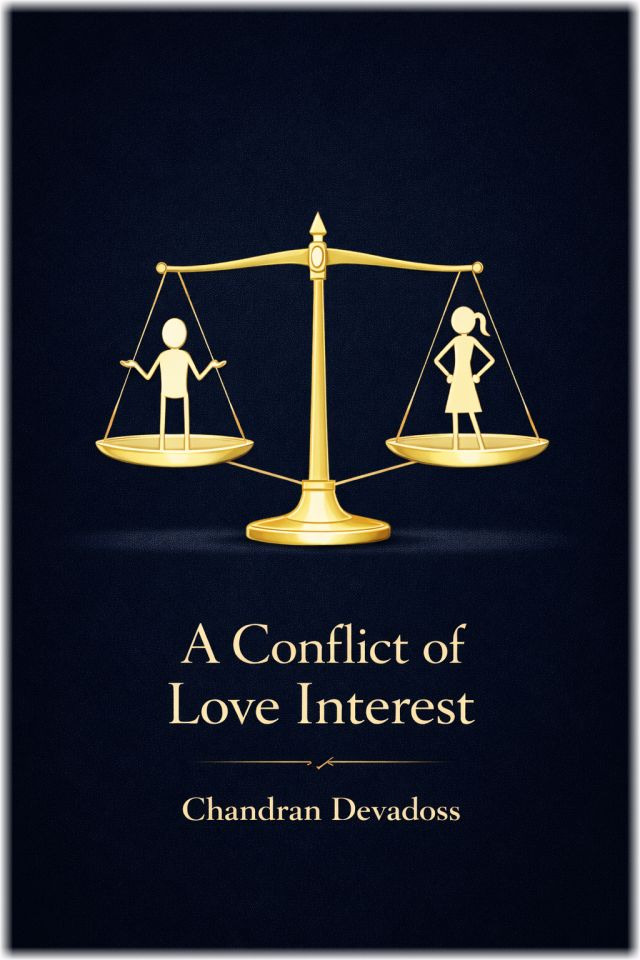
The basic premise of my novel is simple.
Two people who once cared about each other meet again years later, this time on opposite sides of a lawsuit.
People sometimes ask how I came up with that idea, and the question usually comes from one of two directions.
Some assumes it was a carefully engineered project, as if I sat down with a whiteboard, mapped out a concept, and designed the story the way an engineer designs a bridge.
The others assumes the opposite, that it came from some bolt-of-lightning moment where the whole idea suddenly appeared.
The reality is neither.
The seed for this story goes back to 1986.
At the time, I was in the middle of working on my mechanical engineering degree, and I ran into a girl I had dated a few years earlier. There was nothing dramatic about the breakup. No heartbreak, no unresolved drama. We were simply chatting the way people sometimes do when they run into someone from their past.
She mentioned she was considering law school and then tossed out what she thought was a funny comment.
Instead of meeting there, she said it would have been funny if she had sued my company. In her version, she was the lawyer and I was the engineering representative for some technology company. I do not recall her entertaining the possibility that I might own the company. Hmm.
We laughed about it. Just a throwaway joke.
But something about that idea stuck in my head.
What if two people who once knew each other suddenly met again on opposite sides of a lawsuit?
That little moment stayed with me.
Every once in a while over the years, I would mention the idea when talking with friends. The decades rolled by, 1996, 2006, and it was still sitting there in the back of my mind.
At some point, I got it into my head that I wanted to write screenplays as a side hustle. Do not ask me why. In any event, this seemed as good a concept as any, especially if it were dressed up properly.
So I bought screenplay software, learned the basics of the format, and wrote a script.
Then I sent it to a screenplay evaluator, the kind of professional whose job is essentially to take money and tell you everything that is wrong with your screenplay while making it sound like a valuable service. In fairness, it was.
In retrospect, he was right. My screenplay was not good. That was probably around 2012. After that, I moved on and tried writing other screenplays. This story went onto a hard drive somewhere in the cloud and sat there for a very long while, until around 2024.
Then I thought of the story again. But all I had was the PDF. So I thought, why not run it through OCR, recover the text, and reformat it?
So I let AI do the grunt work.
It was not pretty. More like a hot mess, as the kids say these days. But it was a workable collection of scenes. Nowhere close to a novel, more like a pile of material that ran the gamut from laughable to cringey.
From there it was month after month of shaping, rewriting, and reorganizing. Now, the novel may be ready by December 26, 2026. Coincidentally, that is about forty years after the conversation that started all this.
So from the first spark in 1986 to the expected publication date, the idea took roughly four decades to reach the page.
That may sound like a long time to write a book.
But in another sense, it was not time spent writing at all.
It was time spent living.
Those decades were filled with ups and downs, careers, travels, mistakes, remarkable people, and all the other things that give characters their texture. Without those experiences, I doubt I would have had much chance of making the people in this story feel real.
So in one sense, yes, forty years is a long time.
But in another sense, that is simply what it took to get from a spark of an idea to a finished story.
A Couple of Takeaways
First, you never know what might become the seed of a story. Something that starts as a casual joke can stick around for decades.
Second, a story takes the time it takes. You do not measure it by how long it took to write. You measure it by whether it was written well enough when the time finally came.
Ideas do not arrive fully formed. Sometimes they sit quietly for decades, waiting for you to catch up to them.
 Cutting Capers